
Professor Liu Lei‘s team and Professor Zhang Chaoyang’s team, in collaboration with Associate Professor Chi Yuhao (Xidian University) and PhD candidate Huang Shunqi (Japan Advanced Institute of Science and Technology), achieved a breakthrough in communication multiplexing theory. Their work, titled “Random Multiplexing,“ published as a 30-page paper in IEEE Transactions on Information Theory—the premier international journal in the field of information theory—introduces a novel random multiplexing theoretical framework with an integrated solution for optimal signal detection, power allocation, and channel coding that approaches information-theoretic limits and outperforms mainstream technologies such as OFDM, OTFS, and AFDM in representative scenarios.
The research addresses a fundamental challenge in wireless communications: from 1G to 5G, mainstream access technologies have adhered to an ”interference avoidance“ paradigm—rigidly partitioning physical resources such as frequency, time, code, or space to avoid interference. While this approach offers engineering simplicity, it is not theoretically optimal, suffers from low spectral efficiency, and remains vulnerable to selective fading.
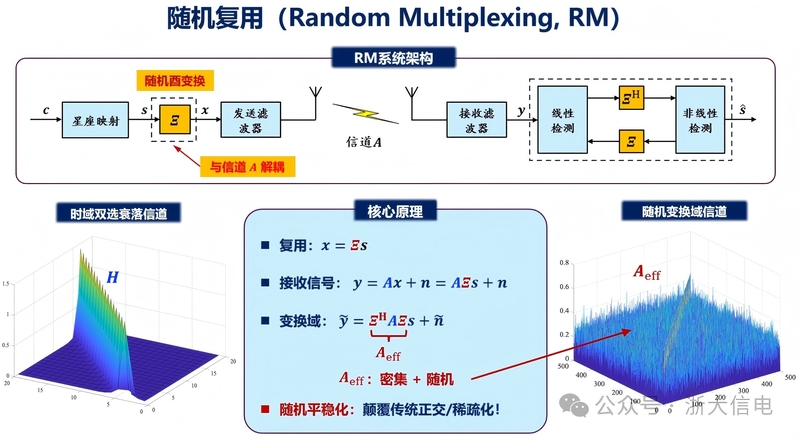
The research team has proposed a paradigm shift from ”interference avoidance“ to ”interference exploitation“ by introducing the random multiplexing framework. The core contributions include channel reshaping through random spreading sequences in the transmit domain, optimal joint detection algorithms derived from Bayesian inference, and the demonstration that the scheme approaches information-theoretic limits while remaining computationally feasible and hardware-friendly. The random multiplexing framework achieves one of the first theoretically optimal yet engineering-feasible solutions for communication over arbitrarily spectrally convergent channels.
Link: https://ieeexplore.ieee.org/document/11369302
